On-Behalf-Of (OBO) Delegations
Console View
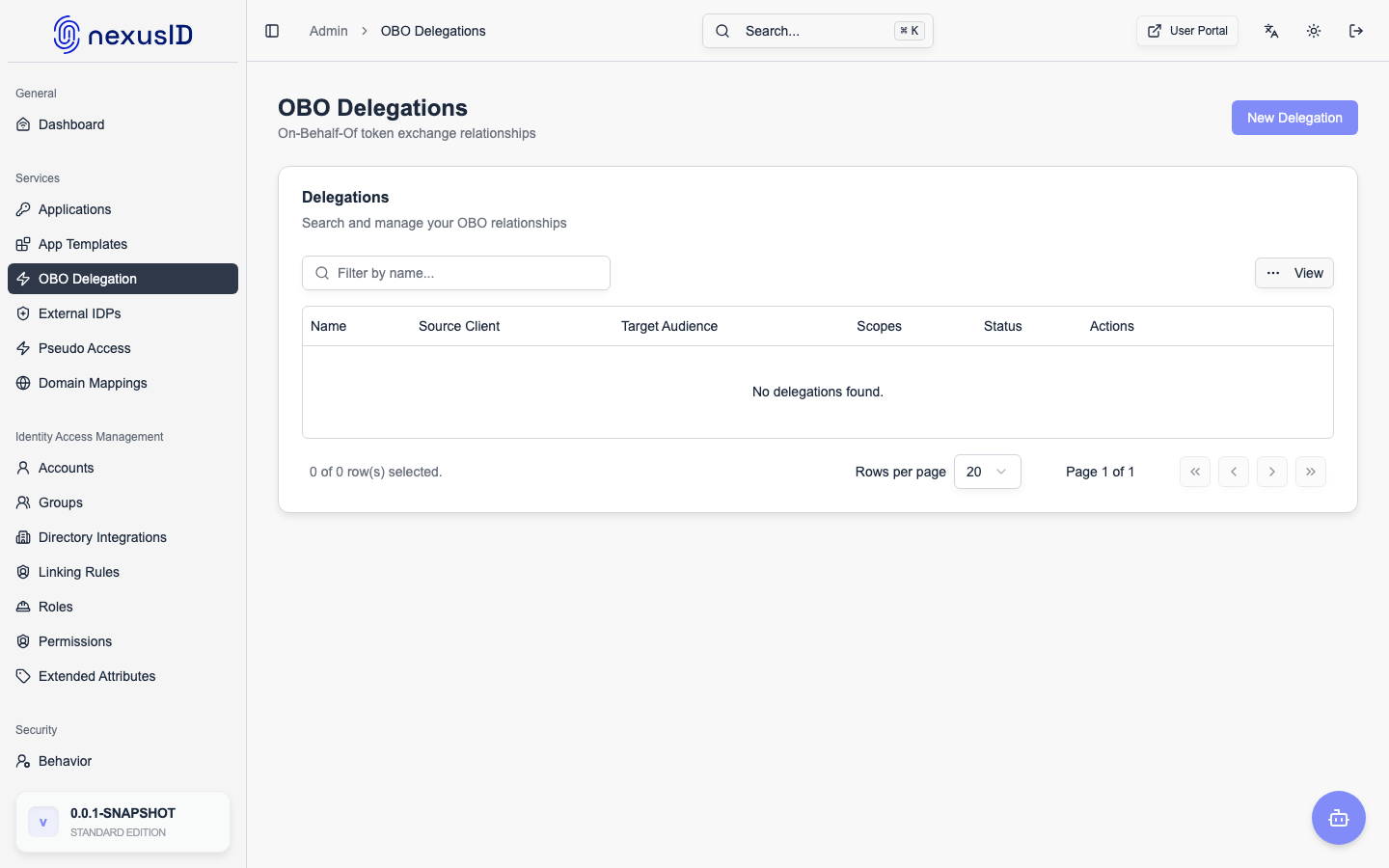
Identity Broker supports the RFC 8693 OAuth 2.0 Token Exchange protocol, which enables the On-Behalf-Of (OBO) delegation flow. This allows a middle-tier service (like an API gateway or backend microservice) to exchange a user's access token for a token that can be used to call a downstream service, while still preserving the user's original identity.
Why Use OBO?
In a microservices architecture, you often have a chain of services. When a user calls Service A, which in turn needs to call Service B, Service A should not simply pass the user's original token to Service B. Instead, it should exchange it for a new token that is specifically intended for Service B (different audience and potentially different scopes).
Delegation Relationships
OBO in Identity Broker is governed by Delegation Relationships. You must explicitly define which services are allowed to perform token exchanges for which target audiences.
Key Fields
- Source Client: The application that will initiate the token exchange (e.g.,
api-gateway). This must be a Confidential Client (with a client secret). - Target Audience: The client identifier of the downstream service for which the new token will be issued (e.g.,
user-service). - Allowed Scopes: The maximum set of scopes that can be granted in the issued OBO token.
- Require Scope Downscoping: If enabled, the system ensures that the requested scopes are a subset of the original user token's scopes.
- Enabled: Quickly toggle the delegation relationship on or off.
Token Exchange Flow
- User Authentication: The user authenticates with Identity Broker and receives an access token for the
api-gateway. - Service Call: The user calls the
api-gatewayincluding their access token in theAuthorizationheader. - Token Exchange: The
api-gatewaycalls the Identity Broker's token endpoint (/oauth2/token) using theurn:ietf:params:oauth:grant-type:jwt-bearergrant type.- It sends the user's access token as the
assertion. - It specifies the
audienceasuser-service.
- It sends the user's access token as the
- Validation: Identity Broker validates:
- The user's token is valid and not expired.
- A delegation relationship exists between
api-gatewayanduser-service. - The user's token has not been replayed (using the Token Replay Cache).
- The requested scopes are allowed.
- Issue Token: Identity Broker issues a new access token with the
user-serviceas the audience and the user's originalsub(subject).
Token Replay Prevention
To prevent a compromised assertion token from being used multiple times, Identity Broker implements a Token Replay Cache.
- Every assertion token's unique identifier (
jti) is tracked. - If a token with the same
jtiis used again, the exchange request is rejected. - This ensures that each user token can only be exchanged for an OBO token once.
Actor Claim (act)
Identity Broker supports the actor (act) claim as defined in RFC 8693. The issued OBO token includes an act claim that identifies the client that performed the exchange. This provides a clear audit trail of who is acting on behalf of the user.
Example token payload:
{
  "sub": "usr_a1b2c3d4",
  "aud": "user-service",
  "iss": "https://idp.identix.com",
  "act": {
    "sub": "api-gateway"
  }
}
Monitoring and Auditing
The OBO Exchange History section in the Admin Console provides a complete log of all token exchange events, including:
- Timestamp of the exchange.
- Source and target clients.
- User subject identifier.
- Success or failure status (with error details).
- Scopes requested and granted.
This level of visibility is critical for troubleshooting and security auditing.